

Key Takeaways
If the stock market crashes the year you retire, selling your investments to fund your lifestyle permanently locks in those losses. This is called the “Bad Timing Tax.” To prevent it, you need a cash buffer that covers your living expenses while your main investments recover.
At Sunlit Path, we use the Plenty pillar of our Path to Prosperity framework to turn your super into an automated, regular pay packet. We keep your daily spending money safe from market drops so you can spend confidently without watching your balance.
The Facts: Under the 2025/2026 superannuation rules, an account-based pension lets you draw tax-free income from age 60. By structuring this pension with a defensive cash bucket, you avoid selling growth assets during a downturn.
The Bad Timing Tax: What Happens to your Super if the Market Crashes When You Retire?
You wake up in Maleny. The morning air is crisp. The coffee is hot. You are officially retired.
Then you turn on the news.
The stock market just dropped 20%.
In an instant, 40 years of work feels fragile. Will your money last? Do you cancel the caravan trip? Do you call your old boss?
This is the moment most retirement plans are truly tested, and most fall short. We call it the Bad Timing Tax. The financial industry calls it Sequence of Returns Risk. Whatever the name, it describes the same brutal truth: stepping out of the workforce at the wrong moment can permanently damage a retirement that looked perfectly fine on paper.
The good news? It does not have to go that way. Whether you live in the quiet hinterland or along the busy coast, you can build an income that holds steady regardless of what the market is doing. You just need a smarter structure for your money.
What exactly is the “Bad Timing Tax”?
While you are working, a market crash is actually an opportunity. Your employer puts money into your super every month. When prices fall, you are buying shares at a discount. Time is on your side.
When you retire, the maths flips.
You are no longer adding to your investment, you are drawing from it. And that changes everything.
Here is a simple example. You retire with $1,000,000. A crash hits and your balance drops 20% to $800,000. But life doesn’t pause for a market recovery and you still need $60,000 this year for groceries, rates, and that trip to K’gari you’ve been promising yourself.
So you sell. You take $60,000 out of a portfolio that is already down. Your balance falls to $740,000. When the market eventually recovers, you have fewer shares left to benefit from the rebound. Those losses are now permanent.
That is the Bad Timing Tax in action. A single bad year at the wrong moment can derail a retirement that had every reason to succeed.

What does history actually tell us?
Market crashes feel catastrophic in the moment. The headlines are designed to alarm. But the data consistently tells a calmer story.
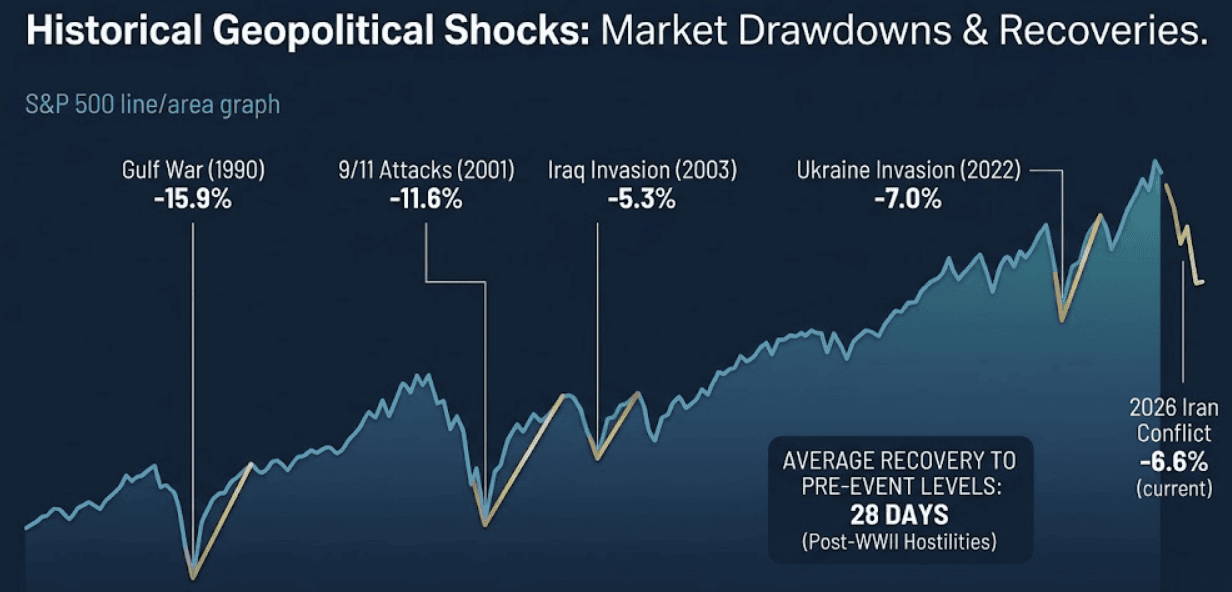
Across more than 20 major geopolitical shocks since World War II, the S&P 500 has taken an average of just 28 days to return to pre-event levels. Not years. Not even months. Twenty-eight days.
The table below shows how markets have responded to some of the most unsettling events in recent decades:
| Geopolitical Event | Immediate Drop | 6-Month Response | 12-Month Response |
|---|---|---|---|
| Gulf War (1990) | -15.9% | Positive | +20% |
| 9/11 Attacks (2001) | -11.6% | Positive | +15% |
| Iraq Invasion (2003) | -5.3% | +18% | +26–35% |
| Ukraine Invasion (2022) | -7.0% | +10% | +15% |
| Iran Strikes (2026) | -6.5% | – | – |
Source: LPL Research, “Geopolitical Events and the S&P 500,” 2024-2026, Ned Davis Research (NDR), “Historical Performance Post-Conflict,” via Hartford Funds, 2026, RBC Wealth Management, “Then and Now: Market Reactions to Military Conflicts,” March 2026.
The pattern is consistent: initial shock, then recovery. In roughly 75% of cases, markets are higher 12 months after a crisis begins than they were before it started. Past performance is not a reliable indicator of future performance and maybe this time is different.
The Bad Timing Tax only bites when you are forced to sell during that initial dip. The goal of good retirement planning is to make sure you never are.
How do you protect your retirement paycheck?
You cannot control the stock market. You can control where your next dollar comes from.
At Sunlit Path, we do not want you checking the financial news over your morning coffee. We want you planning your Tuesday walk to Hell’s Gates, or deciding which weeks to visit the grandkids. That kind of freedom requires total confidence in your income not just your balance.
We eliminate the Bad Timing Tax using a straightforward bucket system. Your money is divided based on when you will actually need it.
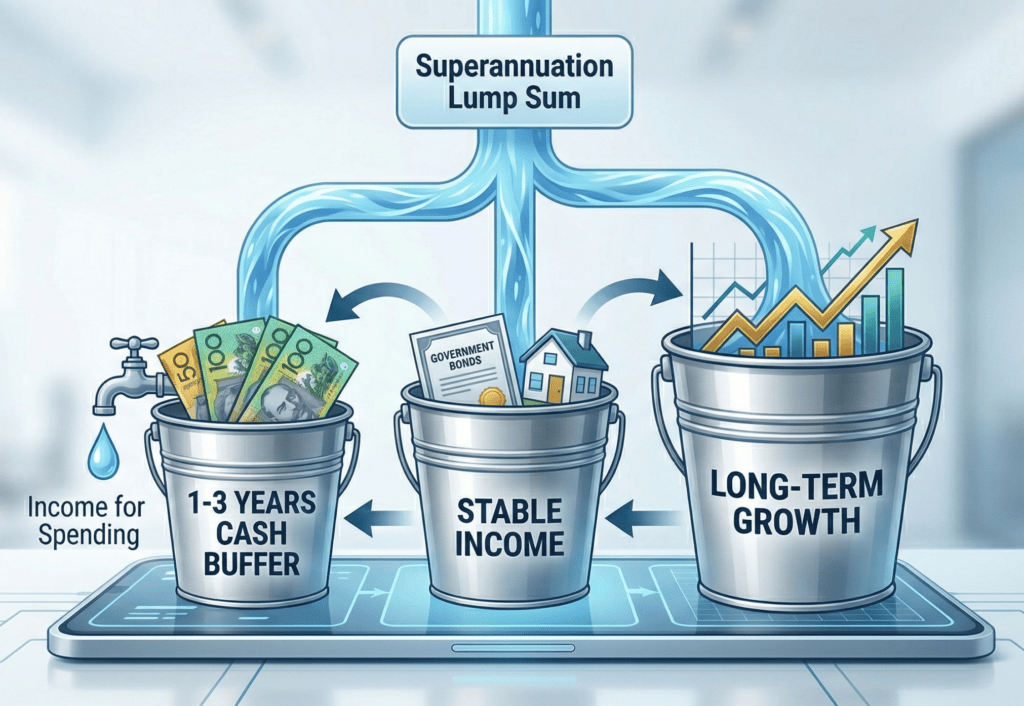
Bucket 1: The Safety Net (Next 1–3 Years)
Your immediate living costs sit in safe, accessible cash and term deposits. If you spend $60,000 a year, this bucket holds roughly $150,000, enough to pay your bills for two to three years without touching anything else. This money does not move with the market.
Bucket 2: The Growth Engine (Years 4 and Beyond)
The rest stays invested in shares and property, growing quietly in the background. This is what protects you against the rising cost of living and keeps your retirement sustainable for the long haul.
When a crash hits, the strategy is simple: we pay you from the Safety Net and leave the Growth Engine alone. Your income arrives on schedule, every fortnight, just as it always does. By the time the Safety Net needs replenishing, the Growth Engine has had two to three years to recover. You never need to sell at a loss.
Want to check your current investments? book a complimentary 30 minute session with Simon.
Why not just move everything to cash?
It feels logical. If cash is safe, why not keep everything in cash?
Because cash has its own danger, one that does not make headlines but quietly devastates retirements.
Money sitting in a savings account earns modest interest but typically fails to keep up with inflation. Over a 30-year retirement, that gap compounds. The real purchasing power of your savings erodes year after year, until the money that felt like “enough” at 65 is genuinely insufficient at 82.
This is longevity risk and for Australians, it is a serious concern. We are living longer, healthier lives than any previous generation. A retirement today could easily span three decades. Your money needs to work hard across that entire period, not just the first few years.
The bucket system solves both problems at once. The Safety Net gives you peace of mind today. The Growth Engine protects your future.
How does a market drop affect my Age Pension?
There is a quiet benefit that most people do not realise: if your super balance falls significantly during a downturn, your government support may actually increase.
The Age Pension is asset-tested. When your assets go down, your entitlement goes up. This means the government partially absorbs the shock of a market crash acting as a floor beneath your retirement income at exactly the moment you need it most.
We help Sunshine Coast clients structure their account-based pension to work alongside Centrelink, not against it. We handle the paperwork, keep your details updated, and make sure you are always receiving the maximum support you are entitled to.
With the personal transfer balance cap at $2.0 million for 2025/2026, most retirees can also keep their income completely tax-free, one less thing to worry about when markets get noisy.
The difference in practice
| Standard Approach | The Sunlit Path Strategy |
| Focused on your total lump sum balance | Focused on your reliable, automated paycheck |
| Market drops trigger panic and calls to sell | Market drops are irrelevant — your cash buffer is paying your bills |
| You check your portfolio before spending anything | You spend without guilt, knowing your income is secure |
| Trying to predict or beat market returns | Building a lifestyle you can sustain and enjoy every day |
Does your current plan account for this?
Any plan can look solid during a bull market. The real test is what happens when the market turns.
Do you know exactly where your income will come from if the ASX drops 20% tomorrow? Do you have a cash buffer already in place? Is your current super structure exposed to the Bad Timing Tax?
If you are not certain and there is a gap, it’s easier to close now than after a crash has already arrived.
Ready to protect your retirement income?
I’m Simon, founder of Sunlit Path Retirement Partners. For over 15 years, I’ve helped Sunshine Coast locals structure their retirement so they can sleep soundly whatever the market is doing.
In a focused 30-minute conversation, we will look at your specific situation and answer the questions that matter most:
- How much cash buffer do you actually need to feel genuinely secure?
- Is your current super exposed to the Bad Timing Tax right now?
- How much reliable, tax-free income can your assets realistically generate?
No sales pitch. No obligation. Just honest answers from someone who has done this work for a long time.
General Advice Warning: This information is general in nature and does not consider your personal financial situation, objectives, or needs. Before acting on the advice, you should consider whether it’s appropriate to you, in light of your objectives, financial situation or needs Please consult a qualified financial adviser before making any decisions.
FAQ (People Also Ask)
How do I protect my super from a market crash?
The most effective protection is a cash buffer — typically one to three years of living expenses held in a high-interest savings account or term deposit, completely separate from your growth investments.
When the market drops, most retirees face an immediate problem: they still need money to live. Without a buffer, the only option is to sell shares at a depressed price. Those sold units can never recover because they are gone. The cash buffer eliminates that forced sale entirely. Your income comes from the safe cash account while your investments sit untouched and wait for the recovery.
Can I lose all my superannuation if the stock market crashes?
No. Losing your entire superannuation balance in a market crash is not a realistic outcome. Australian super funds are required to hold diversified portfolios. Even a “high growth” fund holds a mix of international shares, infrastructure, and fixed income. This diversification acts as a natural shock absorber.
History shows that even severe crashes—the 2008 GFC and the 2020 COVID crash—were temporary. Investors who stayed the course recovered fully. Those who panicked and switched to cash at the bottom locked in their losses permanently.
When is the worst time for the stock market to drop?
The single most damaging moment is the first two years of retirement.
While you are working, a falling market is actually beneficial because your contributions buy more units at lower prices. The moment you retire, that dynamic reverses. You are now selling units. If the market is down 20%, you have to sell significantly more units to get the same $60,000 income. This is the Bad Timing Tax. It compounds over time, potentially exhausting your portfolio years earlier than planned.
Who can help me set up a safe retirement income on the Sunshine Coast?
You need a licensed financial adviser who specialises specifically in retirement income planning.
At Sunlit Path, we focus on building automated, reliable income that holds steady regardless of what the market does. We ensure your super structure integrates with Centrelink and uses a defensive cash bucket so you can stop checking your balance and start living your retirement.
What is sequence-of-returns risk in retirement?
Sequence risk occurs when investment markets drop significantly during the first few years of retirement. Selling growth assets during a downturn to fund income permanent locks in capital losses.
How does a cash buffer strategy protect retirement income?
A cash buffer holds 1 to 3 years of living expenses in secure cash or short-term income options. When equity markets drop, you draw income from the cash buffer without liquidating shares at a loss.