


Economic Update: Key Insights from the Quarter Ending June 2026
It’s been a quarter of two halves. Overseas, a peace deal between the US and Iran brought relief to energy markets. At home, the Reserve Bank raised interest rates again before pausing, and the Federal Budget introduced big changes for property investors.
This quarterly report serves as an important Economic Update for stakeholders and investors.
For those in or nearing retirement, the priorities haven’t changed: protect your income, look after your super and your home, and manage the rising cost of living.
1. Peace in the Middle East Brings Oil Prices Down
After more than three months of conflict, the US and Iran agreed on 14 June to end the fighting and reopen the Strait of Hormuz — a key shipping route for oil. As a result, oil prices dropped sharply:
- Brent crude fell to around US$83 a barrel, down from a peak of US$126 in March
- US crude dropped below US$70 as shipping resumed
What this means for you: Lower fuel and transport costs should flow through to groceries and everyday expenses in the coming months. That’s good news if you rely on a fixed income, the Age Pension, or regular super drawdowns — your money should stretch a little further.
2. Interest Rates: A Pause After Rising — Good News for Savers
The Reserve Bank of Australia (RBA) raised the cash rate to 4.35% in May, the third increase in a row, after inflation came in higher than expected. This added around $225 a month to repayments on a typical $500,000 mortgage.
In June, the RBA held rates steady to see how earlier increases — and falling oil prices — play out. With global tensions easing, further rate rises look less likely, though the RBA hasn’t ruled them out.
What this means if you’re 50+:
- Better rates on savings. Higher term deposit and savings rates are good news if you rely on interest income or run an account-based pension.
- Your pension isn’t affected. Centrelink works out your Age Pension using standard “deeming rates,” not what you actually earn — so shopping around for a better savings rate won’t reduce your pension.
- Annuities look more attractive. Higher yields mean annuities and other lower-risk investments are worth another look.
This is a good time to check in with your adviser about your mix of growth investments, income streams, and cash reserves.
3. Big Changes to Property Tax Rules — But Your Home Is Protected
The Federal Budget, handed down on 12 May, introduced the biggest shake-up of property investment rules in decades. The changes take effect from 1 July 2027:
- Negative gearing on existing (established) properties bought after 12 May 2026 will only be able to offset rental income or future capital gains — not your salary or other income.
- New-build properties keep the full negative gearing benefits.
- The 50% capital gains tax discount is being replaced with inflation indexation, plus a minimum 30% tax rate on gains made after 1 July 2027. Properties bought before 1985 will have any growth after 2027 taxed under the new rules.
- If you already owned property before Budget night, you’re largely grandfathered — the old rules keep applying until you sell.
What this means for you:
- Negative gearing tends to matter less once you’re no longer earning a full wage, so this change affects fewer retirees directly.
- Your family home is fully protected — it stays exempt from capital gains tax and is generally left out of the Age Pension assets test.
- Downsizing is still a great option. From age 55, you can put up to $300,000 per person from the sale of your home into super, without it counting toward your normal contribution caps. It’s a good way to right-size your living arrangements while boosting your retirement savings — just check how it might affect your pension assets test first.
If you own an investment property, it’s worth reviewing your cash flow, long-term plans, and estate strategy with your adviser in light of these changes.
4. Gold and the Aussie Dollar
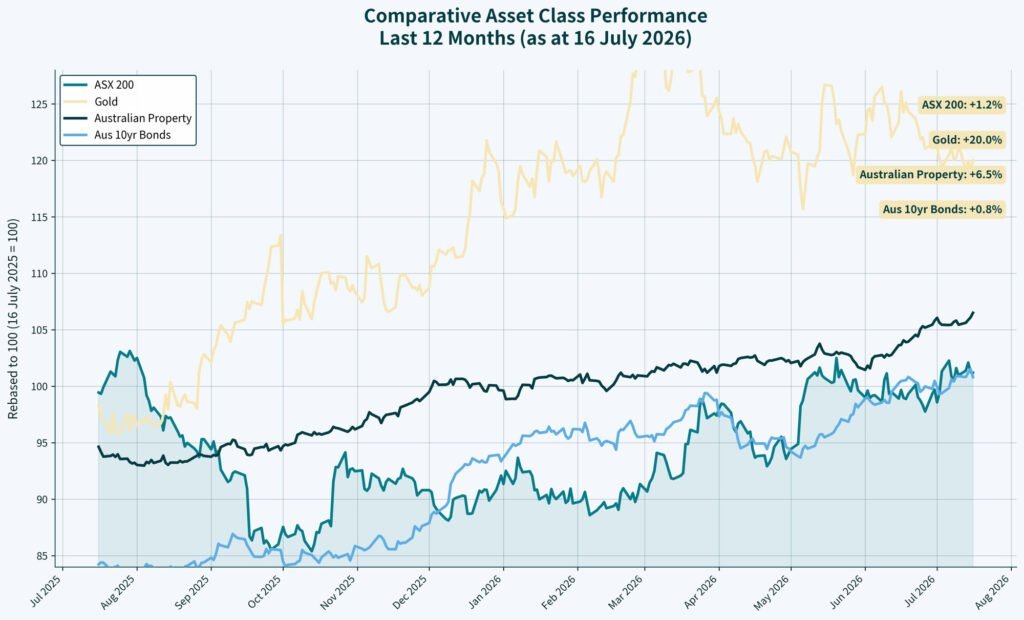
Gold prices eased back from January’s high, dropping below US$4,000 by late June as investors took profits and sentiment shifted. Meanwhile, the US dollar strengthened, pushing the Australian dollar below US$0.70.
This is good news for Australian exporters, but it also means overseas travel and anything priced in US dollars will cost a bit more.
Looking Ahead
Despite all the ups and downs, the ASX 200 still finished the financial year up around 3.5%, sitting near 8,800 points.
The big questions going forward: will the peace deal hold, will lower oil prices keep inflation down, and what will the RBA do next?
For those in or approaching retirement, the priorities remain the same:
- Protect and grow a sustainable income
- Keep the family home as your cornerstone asset
- Manage rising costs like electricity, insurance, and healthcare through concessions and careful budgeting
- Stay diversified across quality investments, and avoid making decisions based on headlines
A steady, well-diversified strategy tailored to your own circumstances continues to be the best approach at this stage of life.
If you have any questions or would like to discuss the above please reach out.
General Advice Warning: This information is general in nature and does not consider your personal financial situation, objectives, or needs. Before acting on the advice, you should consider whether it’s appropriate to you, in light of your objectives, financial situation or needs Please consult a qualified financial adviser before making any decisions.
Sources
No representation is given, warranty made, or responsibility taken about the accuracy, timeliness or completeness of information sourced from third parties. Because of this, we recommend you consider, with or without the assistance of a financial adviser, whether the information is appropriate having regard to your particular circumstances.
- Reserve Bank of Australia (RBA) – Cash Rate and Monetary Policy Decisions:
https://www.rba.gov.au/media-releases/2026/mr-26-15.html
https://www.rba.gov.au/cash-rate-target-overview.html
https://www.rba.gov.au/publications/smp/2026/may - Australian Treasury – Federal Budget 2026 Tax Reforms (Negative Gearing & CGT):
https://treasury.gov.au/policy-topics/taxation/budget2026-27
https://budget.gov.au/content/factsheets/download/tax-explainers-negative-gearing-capital-gains-tax.pdf - Services Australia – Age Pension Assets Test (updated 1 July 2026):
https://www.servicesaustralia.gov.au/assets-test-for-age-pension?context=22526 - Australian Taxation Office (ATO) – Downsizer Contributions:
https://www.ato.gov.au/downsizing - ASFA Retirement Standard (March Quarter 2026):
superannuation.asn.au/wp-content/uploads/2026/06/260223-ASFA-Retirement_Standard-Summary.pdf”>https://www.superannuation.asn.au/wp-content/uploads/2026/06/260223-ASFA-Retirement_Standard-Summary.pdf
https://moneysmart.gov.au/glossary/asfa-retirement-standard
